Who marks
the markers?
Developing Automated Marking
2017–2026: making expert-informed
evaluation and feedback more accessible.
Burt Verster / Matthew Smith
 ThinkActuary
Developing Automated Marking
2017–2026: making expert-informed
evaluation and feedback more accessible.
Burt Verster / Matthew Smith
ThinkActuaryExpert feedback on students’
practice exam answers is
scarce, slow and expensive.
ThinkActuaryThe first Mark prototype tested whether technology could help.
ThinkActuaryStudents gained access to independent feedback. We began building a valuable dataset of actuarial judgement, applied through marking.
Through 30 June 2026.
ThinkActuaryLLMs might offer a path beyond text matching.

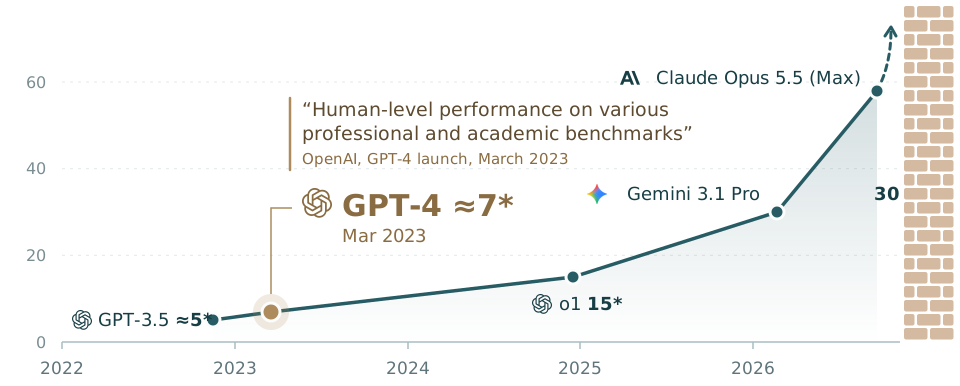
Current index snapshot, plotted by release date. *Approximate / estimated legacy scores.
ThinkActuary Hi, I’m Mark · the new markerNew starter
Keen to become a marker. Well-read, but new to marking actuarial exams.




 Actuary markingThinkActuaryHi, I’m Mark · the new markerIn trainingThinkActuaryHi, I’m Mark · the new markerIn training
Our eval set was valuable, but platform reviews showed the human reference wasn’t perfect either.
2025 Session 2 · Markers with ≥15 student ratings
Auto QA range: 1.88–2.91/5, despite high student ratings.
Slightly left-skewed, with a longer tail towards lower scores.
Full session cohort; shape alone does not establish bias.
ThinkActuaryHi, I’m Mark · the new markerIn trainingPowered by GeminiThinkActuaryHi, I’m Mark · the new markerTrainee (under supervision)Gemini 3.1 Pro powered all workflow steps. Marking doctrine stabilised,
with decent accuracy and consistency.
72 agreements from 101 scripts.
29 disagreements.
Inspectable proposed marks and feedback supported supervised marking.
Average scores hid individual differences. Context and duplicate credit needed work.
ThinkActuaryShared guidance and in-line recommendations could help structure marking and feedback.
Conceptual illustration, not measured results. No same-script, multiple-marker experiment is shown.
ThinkActuary2026 S1. The engine proposes. The actuary reviews, changes and approves.
Inspect each segment’s rationale and confidence. Edit awards, review the overall feedback and approve the result.
“Consider the tax implications if the structure were to change”
Anonymised F103 review, 2026 S1. Record excerpt, not a UI screenshot.
ThinkActuaryThe session before Grader (2025 S2) compared with the first session using it (2026 S1).
More concentrated with Grader; different cohorts, not causal evidence.
Mean score / 5
+1.17 points in mean QA.
Same prompt, balanced samples.
Mean voluntary rating / 5
Zero-to-five scale.
Before Grader: 2020–25.
Median elapsed time
Early estimate, not active work.
62% shorter, including queue time.
Post-review QA proxy.
ThinkActuary2026 S1 Grader: paired segment awards, not whole-script decisions.
8,683 of 9,517
paired segment awards unchanged
Overrides exposed missed credit, over-credit and borderline decisions.
It may reflect good recommendations, human anchoring, or both.
ThinkActuaryStudents get feedback in a matter of minutes, at a quarter of the cost. A311 and selected F100 subjects only.
ThinkActuaryVoluntary ratings in the same six supported subjects, across different cohorts.
10.8% of submitted marks in supported subjects, per the session report.
A311, F102, F103, F105, F106 and F108. No F200 subjects in this beta cohort.
Monitor failures and feedback. Compare matched scripts with human review and test repeatability.
ThinkActuaryWith the release of Auto Mark (Beta),
we made meaningful progress
on the original objective.
Students can access engine-generated feedback without individual actuary review.
Human sign-off is no longer a prerequisite for returning feedback.
A lower-priced route: 25% of the standard credit rate before rounding.
ThinkActuaryBetter feedback can support better learning. The next steps are independent evaluation and stronger feedback.
Proposed retrospective collaboration using scripts already marked by ASSA examiners. We are also working to understand the impact on pass rates.
Use actuary decisions and overrides to refine skills and model choices. Include difficult and borderline cases, and test changes before widening use.
ThinkActuaryIn memory of
His contribution started the journey
that brought us here.
Instrumental in helping us get here.
ThinkActuaryExpert evaluation and feedback were difficult to access.
Auto Mark (Beta) makes useful feedback more accessible.
Exciting possibilities for personalised learning and the rise of the “Agentic Actuary”.